
Kronos: an open foundation model for candlesticks, used as a second opinion
Kronos tokenises OHLCV price bars and forecasts the next candles. How my squeeze pipeline uses it to adjust confidence, how its forecast shows up on every chart, and why it never gets the final say.
Repo: shiyu-coder/Kronos · MIT
Most AI models in my market pipeline write sentences. Kronos is different: it reads price bars. It's an open-source foundation model for financial candlesticks — K-lines — trained on OHLCV data from more than 45 exchanges.
Research and education, not investment advice.
How it works
Kronos has two parts. A specialised tokenizer turns open, high, low, close and volume into discrete tokens — the price-bar equivalent of words. An autoregressive Transformer, pre-trained on those tokens, then predicts the next candles. A KronosPredictor class handles normalisation and sampling, returning forecast bars with future timestamps.
The released sizes range from a 4-million-parameter "mini" model up to about 100 million parameters, small enough to run on ordinary hardware.
Where it sits in my pipeline
After the nightly scan, Kronos produces a short forecast for each candidate and the results are stored alongside the scan. An enrichment step then re-scores each signal's confidence: when Kronos's direction agrees with the setup, the signal gets a small bonus; when it disagrees, the note says so. The forecast level is drawn on every generated chart, so a reader sees the model's view next to the bands and targets.
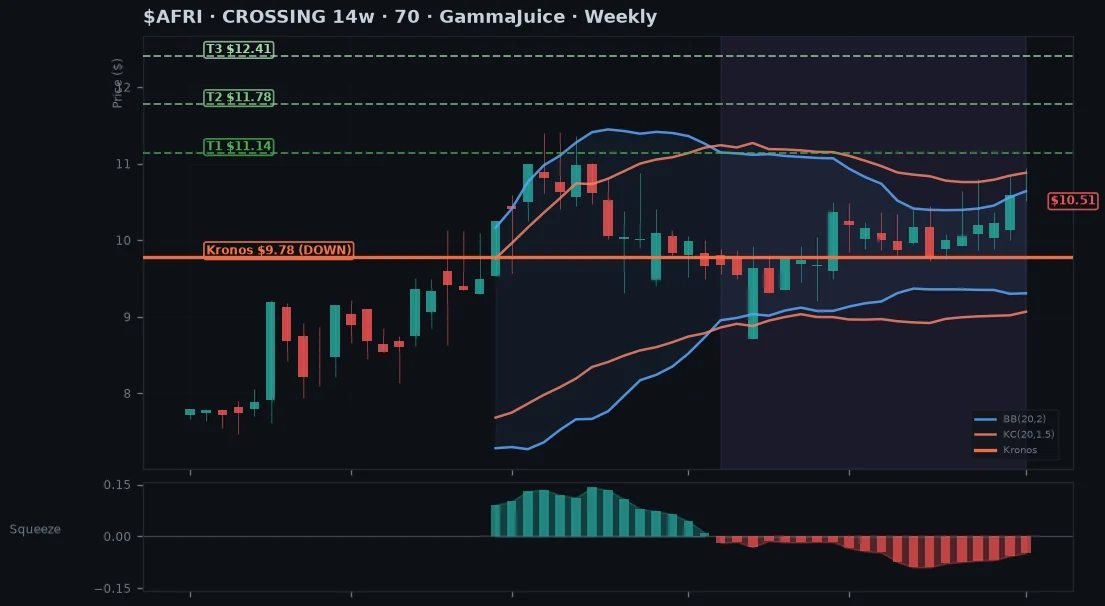
Why it's a nudge, not a vote
- Forecasts are samples, not facts. Temperature and sampling settings change the answer; the same input can produce different paths.
- The scanner's edge is thin already. The stock-level backtest showed a modest profit factor. Adding a model that sounds confident can make a weak signal feel stronger without making it better.
- It needs its own backtest. "Kronos agreed" should be tested like any filter: does it remove more losers than winners on archived signals?
So Kronos adjusts confidence a little and adds context. It never promotes a setup on its own.
Worth trying if…
…you have price data and want a learned baseline to compare your rules against. A foundation model that disagrees with your indicator is useful information either way — as long as you measure which one was right.
Some links in these notes are affiliate links. If you buy through one, I may earn a commission at no extra cost to you. I only link to tools I use or would recommend.